
What it is
A physics course that shows its working.
Gedanken, German for “thoughts”, as in the Gedankenexperiment: the thought experiments that physics was built on.
Gedanken is a course in physics for your phone, written for an intelligent adult who wants to understand how physicists reached each idea: not a specialist, not a child. Every lesson sets up the problem before solving it, explains the reasoning rather than only the result, and tells the history as a story of who was stuck on what.
The equations are real, typeset mathematics, and the derivations unfold one step at a time, each with a paragraph saying what just happened. Interactive models let you push on the ideas, and a short quiz at the end of a lesson lets you check yourself, or skip it.
Finished lessons are remembered on the device, so the home screen shows how far you have come.
Inside a lesson
Six kinds of block, one careful voice.
Connected argument
Paragraphs that lead into each other, with every technical term defined the first time it appears.
Typeset mathematics
Displayed formulas written in LaTeX and drawn in STIX Two Math, with a caption saying what they are.
v = √(2GM / r)
Step by step
Each step is an equation and an explanation. Reveal them with Next step, or show them all at once.
Who, where, why
Asides tagged with a year and a place: 1783 in Thornhill, 1935 at the Royal Astronomical Society.
Models to play with
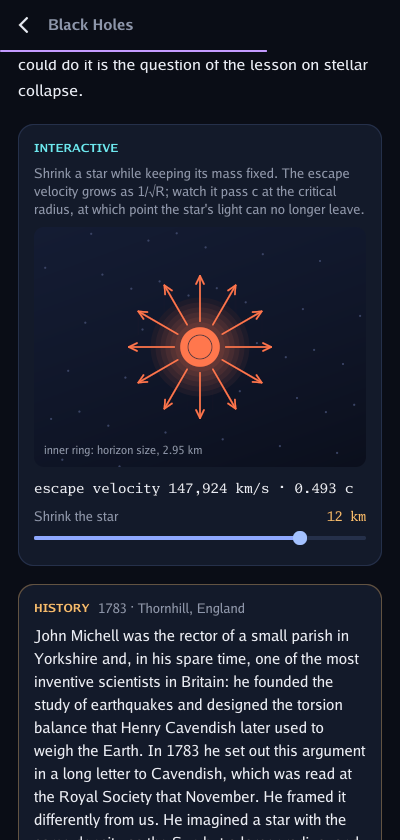
Sliders and live graphics: shrink a star until light can’t leave, or set k and watch a chain reaction grow.
Quizzes and key ideas
Multiple-choice questions with an explanation for the answer, and highlighted notes for the idea to keep.
Screens
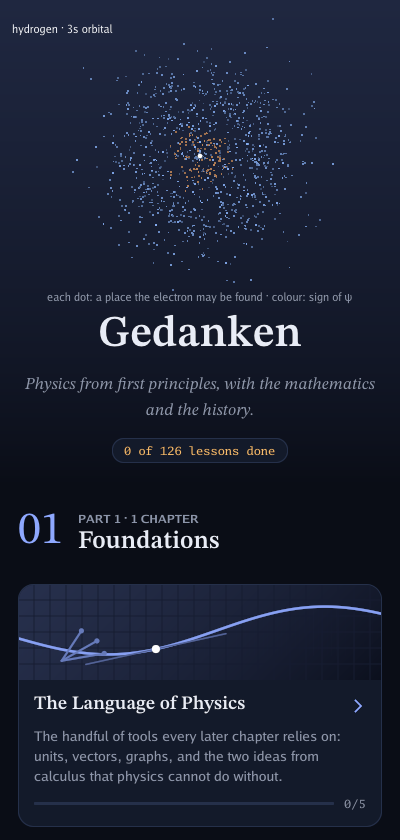
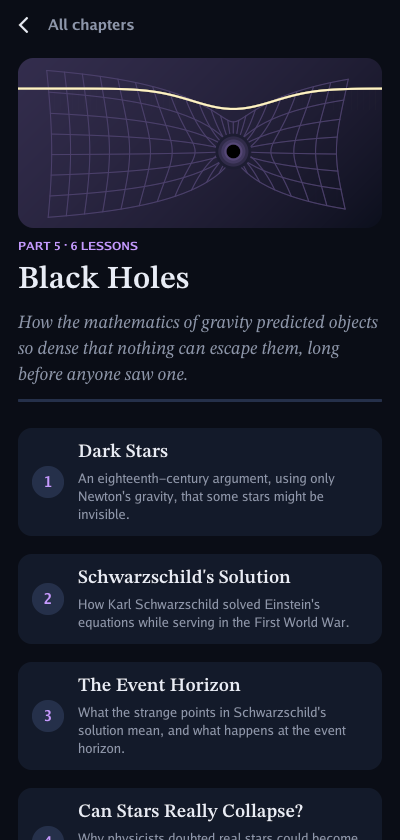
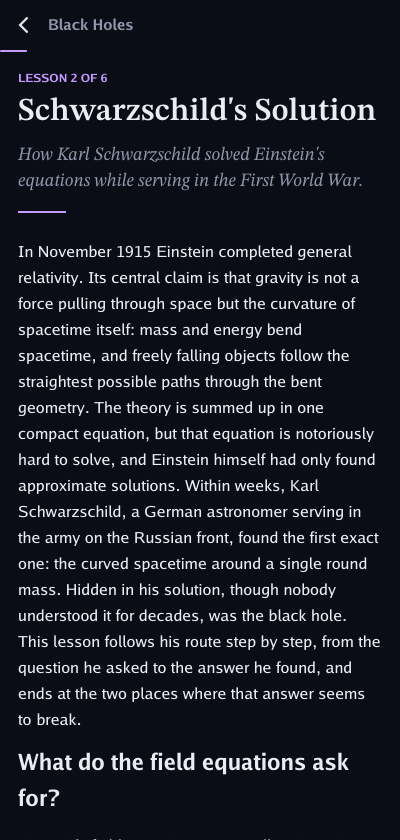
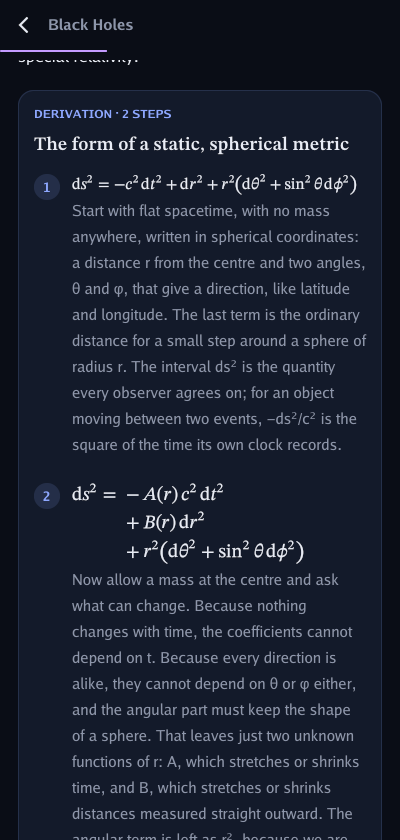
Deep space, set in a book face.
A dark, night-blue reading screen; titles and reading text in STIX Two Text, each part of the course in its own colour.
The course
Eight parts, from units to the Big Bang.
Foundations
5 lessons
- The Language of Physics5
Classical Mechanics
29 lessons
- Motion5
- Forces6
- Energy and Momentum6
- Gravity6
- Oscillations and Waves6
Matter and Heat
9 lessons
- Fluids3
- Thermodynamics6
Electricity and Magnetism
22 lessons
- Electric Charge and Fields5
- Circuits4
- Magnetism5
- Maxwell and Light4
- Optics4
Relativity
17 lessons
- Special Relativity6
- General Relativity5
- Black Holes6
Quantum Physics
11 lessons
- The Birth of Quantum Theory4
- Quantum Mechanics7
Atoms and Nuclei
23 lessons
- The Atom6
- The Nucleus5
- Fission and the Atomic Bomb8
- Fusion4
Particles and Cosmos
10 lessons
- Particle Physics5
- Cosmology5
Interactive models
Ideas you can push on.
Twenty-two live graphics, drawn by the app itself, placed in the lessons where they help.
slopeThe tangent to a curve at a point you dragareaRectangles approximating the area under a curveprojectileLaunch angle and speed, and the trajectory they givefallingA dropped ball, marked every 0.1 sorbitNewton’s cannon: falls back, circles, ellipses, escapespendulumA swinging pendulum; change its length, see its periodwaveA travelling wave with wavelength and frequency slidersinterferenceTwo sources or slits, and their bright and dark fringesgasMolecules in a box; raise the temperature, watch the pressurefield-linesThe electric field of two chargeslight-clockA moving light clock and its time dilation factor γescapeA star shrinking until its escape velocity passes cgravity-wellCurved space around a black hole, and a probe’s clock ratelight-conesLight cones tipping over near a horizonbohrHydrogen’s energy levels: pick a jump, see the photon’s colourwavefunctionA particle in a box: ψ and |ψ|² for each level norbitalHydrogen orbitals from 1s to 3d as probability cloudsatomRutherford’s 1911 planetary picture, labelled as historicaldecayRadioactive nuclei, halving every half-lifebinding-curveBinding energy per nucleon against mass numberchain-reactionGenerations of fission for a chosen kcritical-massNeutrons escaping a sphere of the size you chooseDownload
Take it with you.
Gedanken is built for Android and iOS. Builds are published on the project’s releases page.
Prefer to build it yourself? The source is on GitHub: a Go app made with Giode.
Privacy
Nothing leaves your phone.
Privacy policy · last updated 19 November 2026
- What the app collects
- Nothing. Gedanken has no accounts, no sign-in, no analytics, no advertising, no crash reporting and no tracking of any kind. It does not use the internet at all: it asks for no network permission, and every lesson, formula and model is built into the app.
- What stays on your device
- The list of lessons you have finished, so the home screen can show your progress. It is kept in a small settings file in the app’s own storage on your phone, is never sent to us or anyone else, and is deleted when you uninstall the app. Like other app data, it can be included in your phone’s own backups (Android backup to your Google account, or iCloud and device backups) if you have turned those on.
- Permissions
- None. The app does not use your camera, microphone, photos, contacts, location or notifications.
- Children
- Because the app collects no personal information from anyone, it collects none from children either.
- This website
- This page is hosted on GitHub Pages and loads its fonts from Google Fonts; both see the usual web request data, such as your IP address, under their own privacy policies. The page sets no cookies and runs no analytics.
- Changes and contact
- If this policy changes, the new version will be published here with a new date. Questions go to the project’s issue tracker on GitHub.